

A prescription bottle on a blue background has white pills spilling out of it

Quick Guide to Co-pay Accumulators and Maximizers, & Alternative Funding Programs

In Triage Cancer's free Quick Guide to Co-pay Accumulators and Maximizers, & Alternative Funding Programs, you'll learn about co-pay assistance, accumulators and maximizers, alternative funding programs, how these programs affect your out-of-pocket costs, how to find out if your plan uses them, and more.
The cost of prescription drugs can be a major financial challenge for people coping with a cancer diagnosis. To help, some drug manufacturers and nonprofit organizations offer financial assistance to cover costs patients would normally pay out-of-pocket.

Some health insurance plans have changed how they handle this financial assistance, through programs called co-pay accumulators, co-pay maximizers, and alternative funding programs. Understanding these programs can help you better plan for the true costs you will have to pay, understand your rights, and find options for financial help.

What is a Co-payment?

Co-payment (co-pay): a fixed amount you pay out-of-pocket when you fill a covered prescription, usually at the pharmacy.

Your co-pay amount depends on your plan’s drug formulary, which is the list of drugs your plan covers. The formulary groups drugs into levels, or tiers, with a different cost for you at each tier. At lower tiers you usually pay a co-payment (e.g., $10). At higher levels, you may have to pay a co-insurance amount, which is a percentage (e.g., 20%).

What is an Out-of-Pocket Maximum?

Out-of-pocket maximum: a fixed dollar amount that is the most that you will have to pay for your medical expenses out-of-pocket during the year.

Generally, you reach your out-of-pocket maximum by paying your deductible, plus any co-pays and co-insurance amounts that you pay during the year. Once you reach your out-of-pocket maximum, you will continue to pay your monthly premiums, but your insurance pays 100% of your medical expenses for the rest of the year. It is important to know what your plan’s out-of-pocket maximum is, and what costs are included. Your plan may have a separate out-of-pocket maximum for prescriptions drugs.

What is a Co-pay Assistance Program?

Co-pay assistance programs are typically offered by:

  • Drug manufacturers for brand name medications
  • Nonprofit organizations that help patients with specific conditions

These programs can help pay your out-of-pocket costs for prescription drugs. For example, if your co-pay is $100, the manufacturer provides a $100 co-pay card, so that you would pay $0 when you pick up your prescription at the pharmacy.

What is a Co-pay Accumulator Program?

A co-pay accumulator is a program used by some health insurance plans to prevents co-pay assistance from counting toward your deductible or out-of-pocket maximum.

Example:

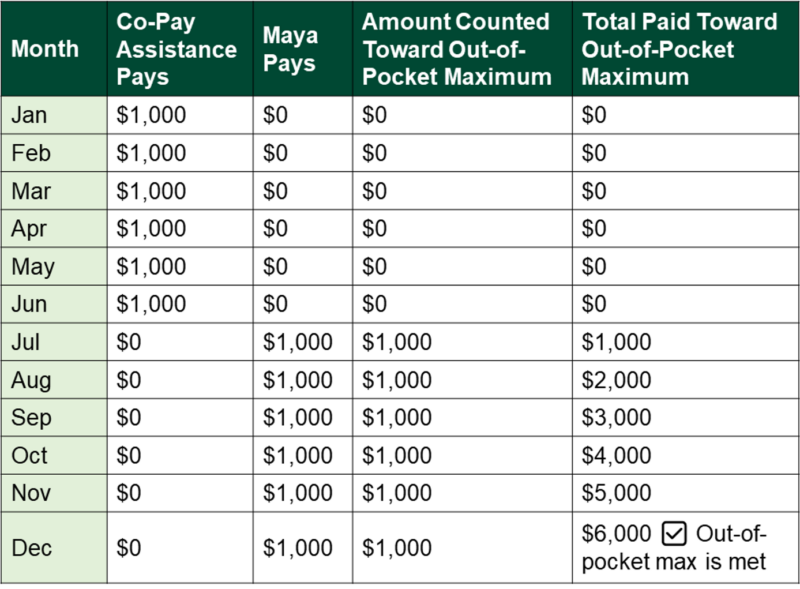
  • Maya’s prescription’s out-of-pocket costs: $1,000/month
  • Maya’s plan’s out-of-pocket maximum: $6,000/year
  • Co-pay assistance amount: $1,000/month up to $6,000/total

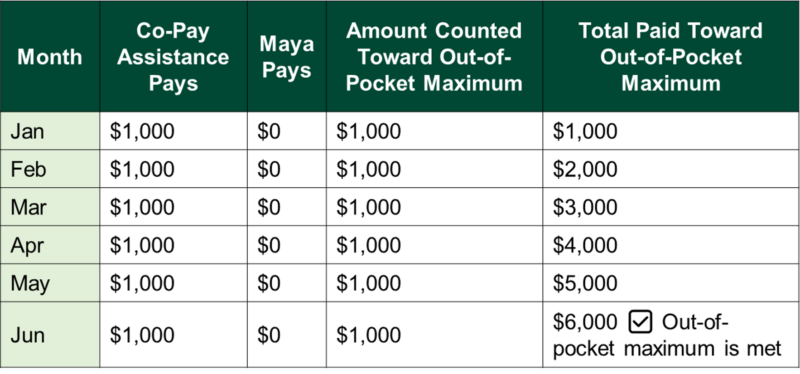
Without a Co-Pay Accumulator (Assistance Counts)

Table showing monthly co-pay assistance of $1,000 from January through June, with Maya paying $0 each month. The full $1,000 counts toward the out-of-pocket maximum each month, reaching $6,000 in June, when the out-of-pocket maximum is met
  • Maya does not pay anything when she picks up her prescription and would reach her out-of-pocket maximum in June. She would not pay anything else for covered medical care for the rest of the year.

With a Co-Pay Accumulator (Assistance Does NOT Count)

Table showing co-pay assistance covering $1,000 per month from January through June with Maya paying $0, but none of it counting toward the out-of-pocket maximum. From July through December, assistance ends and Maya pays $1,000 per month, which counts toward the out-of-pocket maximum, reaching $6,000 in December when the maximum is met.
  • With the co-pay accumulator, Maya does not make progress toward reaching the out-of-pocket maximum while co-pay assistance is used, and ends up paying $6,000 out-of-pocket.

What is a Co-pay Maximizer Program?

A co-pay maximizer works differently than a co-pay accumulator. Instead of applying the financial assistance first, until it runs out, the insurance company will spread the total amount of the co-pay assistance across the plan year.

Example:

  • Maya’s prescription’s out-of-pocket costs: $1,200/month
  • Maya’s plan’s out-of-pocket maximum: $6,000/year
  • Co-pay assistance amount: $12,000/total for the year

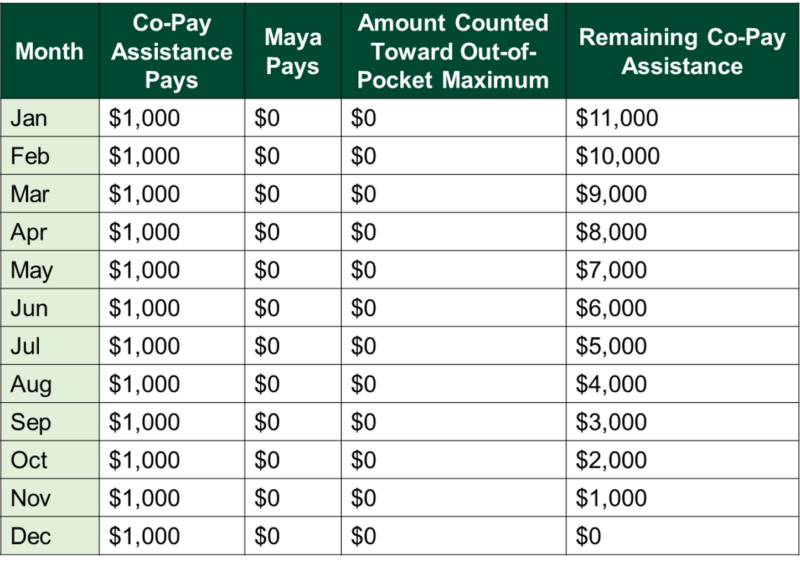
With a Co-Pay Maximizer

Table showing monthly co-pay assistance of $1,000 from January to December, with Maya paying $0 each month. None of the assistance counts toward the out-of-pocket maximum, and remaining assistance decreases from $11,000 in January to $0 in December.
  • With a maximizer, the plan changes her out-of-pocket cost to match the total co-pay assistance available and spreads it out across the full year. This means Maya would pay $0 out-of-pocket for her prescription, but does not make progress toward reaching the out-of-pocket maximum and will have to pay her out-of-pocket costs for other health care she receives.

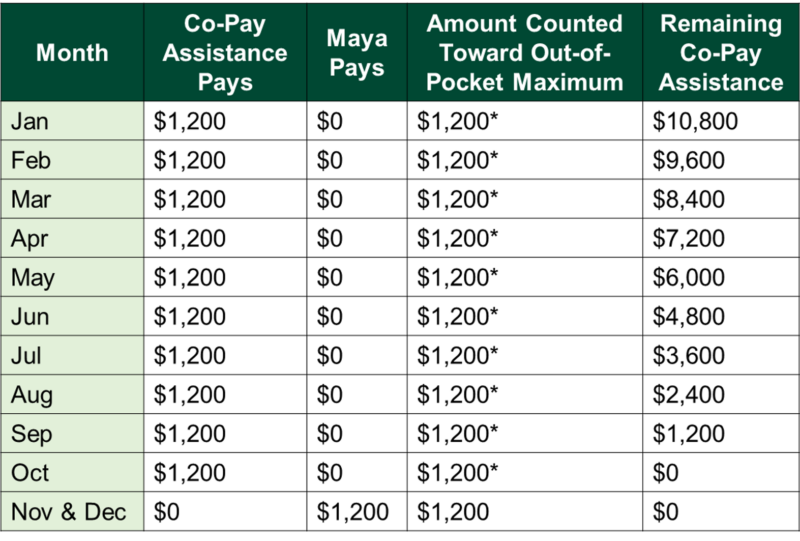
Without a Co-Pay Maximizer

Table showing $1,200 monthly co-pay assistance counted toward the out-of-pocket maximum through October, with assistance ending and patient payments beginning in November and December.

Assistance is used up by October. Maya may owe $1,200 in November and $1,200 in December, if she has not met her out-of-pocket maximum with other health care expenses during the year.

*Whether the co-pay assistance counts toward the out-of-pocket maximum depends on if her plan is also using a co-pay accumulator.

Are Co-pay Accumulators and Maximizers Allowed?

It depends on where you live and the type of health insurance plan you have.

Federal Rules

  • Federal regulations currently allow health plans to use accumulator and maximizer programs, except when the medication does not have a generic equivalent.
  • Federal rules have changed several times in recent years, so this is an evolving issue.

State Laws

  • As of 2026, more than 25 states have passed laws that ban or limit co-pay accumulator programs. Visit: TriageCancer.org/StateLaws for more information.
  • Note: these state laws only apply to fully insured
    plans (e.g., Marketplace plans, insured employer plans). These state laws do not apply to self-insured employer plans.

What Is a Self-Insured Plan?

  • Self-insured (or self-funded) health plan: the employer pays for employees’ medical claims directly, instead of buying a policy from an insurance company.
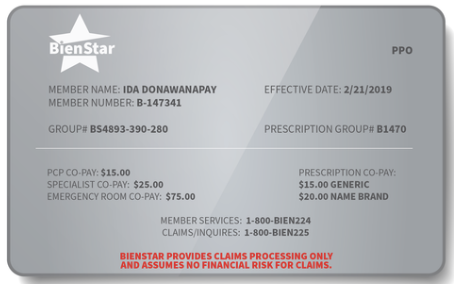
  • A third-party administrator (TPA), may administer benefits, process claims, and manage the prescription drug benefit for the employer. That can be confusing because those TPAs are often insurance companies and an employee may have an insurance card with the logo of an insurance company, but it is the employer that is assuming the cost of claims. See this sample insurance card with self-insured language in red.

How to Tell If Your Plan Is Self-Insured?

  • Review your plan documents, including the Summary Plan Description (SPD). It may state whether the plan is “self-insured” or “self-funded.”
  • Ask your HR or benefits administrator: “Is our group health plan self-insured?”
  • Statements in plan materials like “ERISA plan,” “self-insured employer plan,” or “providing claims processing only,” are clues that you have a self-insured plan.

How to Find Out if Your Plan Uses These Programs?

  • Review your Summary of Benefits and Coverage (SBC) or your Plan Documents (also called Evidence of Coverage).
  • Look for terms like “co-pay accumulator adjustment,” “co-pay offset program,” “co-pay maximizer,” “coupon adjustment,” “co-pay leveling program,” “benefit plan protection program,” or “out-of-pocket protection program.”
  • Contact your insurance company’s member services and ask directly: “Does my plan have a co-pay accumulator or maximizer program that affects co-pay assistance?”
  • If your coverage is through your employer, ask your HR or benefits administrator whether your plan includes one of these programs.
  • It is also important to ask if using these programs is required by your employer-sponsored plan. In some cases, you may be able to opt out, if you ask.

What Are Alternative Funding Programs (AFPs)?

Alternative Funding Programs are used by some employers to manage the cost of expensive medications. These programs remove certain high-cost drugs from the plan’s formulary, arguing that those drugs are not required to be covered (i.e., they are not “essential health benefits”). Employees then have to get financial assistance to pay for those drugs.. Employees then have to get financial assistance to pay for those drugs.

How They Work:

  • The AFP tells the patient that their medication is not covered by their health plan.
  • The AFP applies to manufacturer or nonprofit assistance programs on the patient’s behalf.
  • If funding is not available, the AFP may try to import the medication from abroad. If that is not an option, the patient may have to pay the full cost of the medication or switch to another medication.

Key Concerns:

  • Patients are being denied coverage for medically necessary drugs that would otherwise be covered.
  • AFPs can delay treatment while financial assistance is being applied for.
  • AFPs use charitable funds meant for uninsured or underinsured patients. This can reduce access to those programs for those who truly need them.
  • The patient’s out-of-pocket spending may not count toward their deductible or out-of-pocket maximum, because the drug is “not covered” by the plan.

How to Find Out if Your Plan Uses These Programs?

Here are some signs that your employer-sponsored health plan is using an AFP:

  • Stops covering all or some specialty medications
  • Calls specialty medications “non-essential health benefits”
  • Says you have to enroll, or you will be responsible for 100% of your medication costs
  • Asks you to sign a consent form so that they can apply for financial assistance for you
  • Says that you can’t appeal a coverage denial
  • Some examples of AFP vendors include: Archimedes, Horton, ImpaxRx, PaydHealth, SaveOnSP, PrudentRx, Payer Matrix, PriceMDs SHARx, ScriptSourcing

What if Your Plan Isn’t Covering Your Medication?

  1. File an Appeal.
    You have the right to appeal an insurance denial, through an internal and external appeal. Work with your health care team to explain why a medication is medically necessary for you. Learn more: TriageCancer.org/Appeals
  2. Check for Patient Assistance Programs.
  3. Change Your Insurance Plan. Check to see if you can change your insurance plan during the next open enrollment period, to one that doesn’t use a co-pay accumulator, maximizer, or AFP.
  4. Talk to Your Employer’s HR Department. Share your experience with co-pay accumulator, maximizer, or AFP programs, and encourage your employer to change

For more information about navigating health insurance, visit: TriageCancer.org/HealthInsurance

Disclaimer: This handout is intended to provide general information on the topics presented. It is provided with the understanding that Triage Cancer is not engaged in rendering any legal, medical, or professional services by its publication or distribution. Although this content was reviewed by a professional, it should not be used as a substitute for professional services. © Triage Cancer 2026

Sharing Triage Cancer's Quick Guide to Co-pay Accumulators and Maximizers, & Alternative Funding Programs

We're glad you enjoy this resource! Please feel free to share this resource with your communities or to post a link on your organization's website. However, this content may not be reproduced, in whole or in part, without the express permission of Triage Cancer. Please email us at info@TriageCancer.org to request permission.

This Quick Guide can be downloaded and printed for free. If you are a health care professional, we provide free, bulk copies of many of our resources. To make a request, visit TriageCancer.org/MaterialRequest.