Checklist: Medicare Initial Enrollment

This checklist is for people who are enrolling in Medicare for the first time.

Most people first qualify for Medicare when they turn 65. Others qualify earlier if they receive Social Security Disability Insurance (SSDI) benefits. Your Initial Enrollment Period (IEP) lasts for seven (7) months. It includes the 3 months before, the month of, and the 3 months after you first qualify for Medicare. If you’re turning 65, your IEP is the 7 months surrounding your birthday month. (If your birthday is on the first day of the month, your IEP starts one month earlier.) If you’re receiving SSDI, your IEP is the 7 months surrounding your 25th month of receiving benefits.
Step 1: Find out whether you will automatically be enrolled in Medicare or whether you must contact the Social Security Administration (SSA) to sign up.

  • If you are turning 65 and you’re already receiving early retirement benefits from SSA, or if you are not yet 65, but have been receiving SSDI benefits for 24 months, SSA should automatically enroll you in Medicare Parts A and B. Watch for paperwork in the mail about three months before your coverage will start.
  • If you do not receive any benefits from SSA, you must sign up for Parts A and B yourself. You can do this by:
  • If you or your spouse worked for a railroad, Medicare enrollment is through the Railroad Retirement Board. For more information, visit rrb.gov/Benefits/Medicare

Step 2: Get your health care information ready.

  • Make a list of your current medications. Include the names, doses, and how much you take each month.
  • Make a list of the pharmacies where you go to get your medications. You can include your current pharmacy, but can also include others near to you.
  • Make a list of your preferred health care providers, including doctors, hospitals, and specialists.

Step 3: Choose how you want to get Medicare.

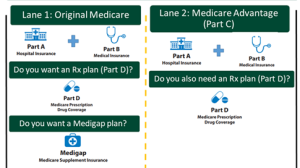
  • Medicare offers different ways to get health and drug coverage. The choices that a family member or friend make may not be the best choices for you. Do your best to make choices that cover the health care providers you want to see, and the medications you take, at prices you can afford. People with Medicare can generally choose coverage from one of the lanes shown below.
  • For additional information about the parts of Medicare, the different options, and costs, review the following resources:

Step 4: Compare plan options.

  • Visit Medicare.gov/Plan-Compare to use Medicare’s Plan Finder tool to compare plan options. You don’t need an online Medicare account to use Plan Finder. If you need help with Plan Finder, watch our video, How to Use Medicare Plan Finder.
  • Use Plan Finder to view Medicare Advantage Plan (MAP) options and/or Part D Prescription Drug Plan (PDP) options that are available based on where you live.
    • Considerations for MAPs
      • What will the plan cost? Look at the plan’s premium, deductible, and out-of-pocket maximum. Also check the co-pays and co-insurance amounts. Calculate the total cost of the plan by using our Medicare Comparison Calculator & Worksheet: TriageCancer.org/Worksheet-Medicare
      • Are all of your health care providers in-network for the plan? Does the plan provide out-of-network coverage?
      • If you take prescription drugs:
        • What will your drugs cost? Look at the plan’s drug deductible and out-of-pocket maximum. Also check the co-pays and co-insurance amounts. Remember that the plan’s out-of-pocket maximum for prescription drugs is separate from the plan’s out-of-pocket maximum for medical care.
        • Are each of your drugs on the plan’s formulary?
        • Do any of your drugs have coverage restrictions (i.e., quantity limits, prior authorization, or step therapy requirements)?
        • Do you want to enroll in the Medicare Prescription Payment Plan? To learn more, review our Quick Guide to the Medicare Prescription Payment Plan: TriageCancer.org/Quick-Guides/MedicarePrescriptionPaymentPlan
    • Considerations for PDPs
      • What will the plan cost? Look at the plan’s premium, deductible, and out-of-pocket maximum. Also check the co-pays and co-insurance amounts.
      • If you take prescription drugs:
        • Are each of your drugs on the plan’s formulary?
        • Do any of your drugs have coverage restrictions (i.e., quantity limits, prior authorization, or step therapy requirements)?
        • Do you want to enroll in the Medicare Prescription Payment Plan? To learn more, review our Quick Guide to the Medicare Prescription Payment Plan: TriageCancer.org/Quick-Guides/MedicarePrescriptionPaymentPlan
  • What if I can’t find certain information in Plan Finder?
    • To find information about which insurance plans your health care providers accept:
      • Check each health care provider’s website. Most list the insurance plans they accept in their “Insurance” or “Finances” sections.
      • Call your health care provider’s office to confirm anything you find on their website or, if you’re unable to find the information on their website, ask which plans they accept.
    • Details about drug restrictions
      • Plan Finder includes details about quantity restrictions (e.g., 30 pills per month), as well as whether or not a drug has prior authorization or step therapy requirements. To find more information about prior authorization or step therapy requirements, you can visit the plan’s website to view the plan formulary.

Step 5: Compare Medigap options.

  • If you choose Original Medicare, and you want to limit your out-of-pocket costs, you may want a Medigap plan. Medigap plans are sold by private insurance companies. You cannot get a Medigap plan if you enroll in a MAP. To learn more about Medigap options, review our Quick Guide to Medigap Plans: TriageCancer.org/QuickGuide-Medigap
  • There is a six (6) month Medigap Open Enrollment Period that starts the first month you have Medicare Part B and you are 65 or older. This is the best time to purchase a Medigap because insurance companies cannot deny coverage due to a pre-existing health condition. If you are under 65, you may or may not be able to purchase a Medigap plan. For details, review our chart about Medigap State Laws: TriageCancer.org/State-Laws/Medicare
  • Visit Medicare.gov/Plan-Compare to see information about insurance companies that offer Medigap plans in your state, as well as costs. Your state’s insurance department may also have information.

Step 6: Take action.

  • To sign up for a MAP or PDP: You can enroll online at Medicare.gov or call 1-800-MEDICARE. You can also enroll by calling the MAP or PDP directly; however, enrolling through Medicare may leave less room for error.
  • To sign up for a Medigap plan: Contact the private insurance company directly.
  • Write down confirmation numbers and notes from phone calls. Print or save any electronic confirmations.

Step 7: After enrollment.

  • Watch for your new plan cards and other materials in the mail.
  • Cancel any coverage you no longer need (or confirm it’s been cancelled.)
  • Update automatic payment information with your plan(s.)
  • Share your new plan information with your health care providers and pharmacies. Take your cards with you the next time you visit them.
  • Start using your new coverage.
  • Don’t forget about other enrollment opportunities throughout the year:
    • If you select a MAP during your IEP and the coverage isn’t working for you, you can make a change within the first three (3) months you have Medicare. During this time, you can change MAPs or you can switch to Original Medicare and join a PDP.
    • Depending on your situation, you may be eligible for a Special Enrollment Period (e.g., when you move out of your MAP’s service area.)
    • For more information about Medicare enrollment periods, read our Quick Guide to Medicare Enrollment Periods: TriageCancer.org/QuickGuide-MedicareEnrollment

Step 8: Get help if you need it.

  • Contact your State Health Insurance Assistance Program (SHIP). SHIPs provide free, unbiased, individualized counseling and assistance for Medicare beneficiaries and their caregivers. States call their SHIPs by different names. To find contact information for your SHIP, visit TriageCancer.org/StateResources
  • Call 1-800-MEDICARE
  • Contact our Legal & Financial Navigation program by visiting TriageCancer.org/GetHelp
  • A note about insurance agents and brokers: some people make Medicare decisions with help from an insurance agent or broker. Be aware that they may be paid, at least in part, based on the plan(s) you choose, which can affect their recommendations.

For more information about Medicare and Initial Enrollment, check out our Medicare Resources: TriageCancer.org/Medicare

Updates: 01/2026

Disclaimer: This handout is intended to provide general information on the topics presented. It is provided with the understanding that Triage Cancer is not engaged in rendering any legal, medical, or professional services by its publication or distribution. Although this content was reviewed by a professional, it should not be used as a substitute for professional services. © Triage Cancer 2026

Sharing Triage Cancer's Checklist to Medicare Initial Enrollment

We're glad you find this resource helfpul! Please feel free to share it with your communities or to post a link on your organization's website. However, this content may not be reproduced, in whole or in part, without the express permission of Triage Cancer. Please email us at info@TriageCancer.org to request permission.

This Quick Guide can be downloaded and printed for free. If you are a health care professional, we provide free, bulk copies of many of our resources. To make a request, visit TriageCancer.org/MaterialRequest.