Quick Guide to the Medicare Prescription Payment Plan (MPPP) in 2026
This Quick Guide explains the 2026 changes to Medicare Part D and the new Medicare Prescription Payment Plan (MPPP) that were included in the Inflation Reduction Act of 2022 (IRA).

This Quick Guide explains the 2026 changes to Medicare Part D and the new Medicare Prescription Payment Plan (MPPP) that were included in the Inflation Reduction Act of 2022 (IRA).
Medicare is a government health insurance program for seniors and people with disabilities. Medicare coverage is broken up into different parts. Medicare Part A is hospital insurance, and pays for your medical care when you are staying in a hospital. Medicare Part B is medical insurance, and pays for visits to your doctor, lab tests, scans, medical equipment, and IV chemotherapy. Parts A and B together are called Original Medicare.
Medicare Part C plans, also called Medicare Advantage plans, are sold by private insurance companies. They are an alternative to Original Medicare and include services covered under Parts A and B. Medicare Part D is prescription drug coverage. Part D plans are offered by private insurance companies. If you have Original Medicare, you can buy a Part D prescription drug plan. Most Part C plans also include Part D coverage for prescription drugs. If you have a Part C plan without drug coverage, you can buy a Part D plan. For details about parts of Medicare, read our Quick Guide to Medicare – Extended or watch our Medicare Animated Video Series.
Part D coverage has three key stages:
Important considerations:
MPPP is a program that started January 1, 2025, that allows people with Medicare Part D coverage to pay their out-of-pocket (OOP) prescription drug costs in monthly installments instead of all at once at the pharmacy. This applies both to Medicare Part D plans and those who have Medicare Advantage Part C plans that include prescription drug coverage.
When an individual goes to the pharmacy to get their prescription drugs, they will pay $0. They will then get a monthly bill from their Part D or Part C plan specifically for the cost of their prescription drugs. This is different than your Part D or Part C plan monthly premium bill, which you will also get. Your Part C or Part D plan will pay the pharmacy for the cost of the drugs.
There is no interest charged on the payments when you are using the MPPP. You can pay the monthly payments by check, credit card, or debit card.
If you are late for a payment, your plan will send you a reminder notice within a couple of weeks after you miss payment. Your plan must allow you 2 months to make a missing payment. If you pay the bill during this time, you can continue in the MPPP. If you do not make the payment within the 2-month timeframe, your plan can remove you from the MPPP. Missing a MPPP payment will not impact your Part D or Part C plan coverage. The only way you can be removed from your Part D or Part C plan is if you do not pay your plan’s monthly premiums.
You can cancel your MPPP participation at any time, but if you decide to cancel, you must pay the balance of what is left on your payment plan for the year.
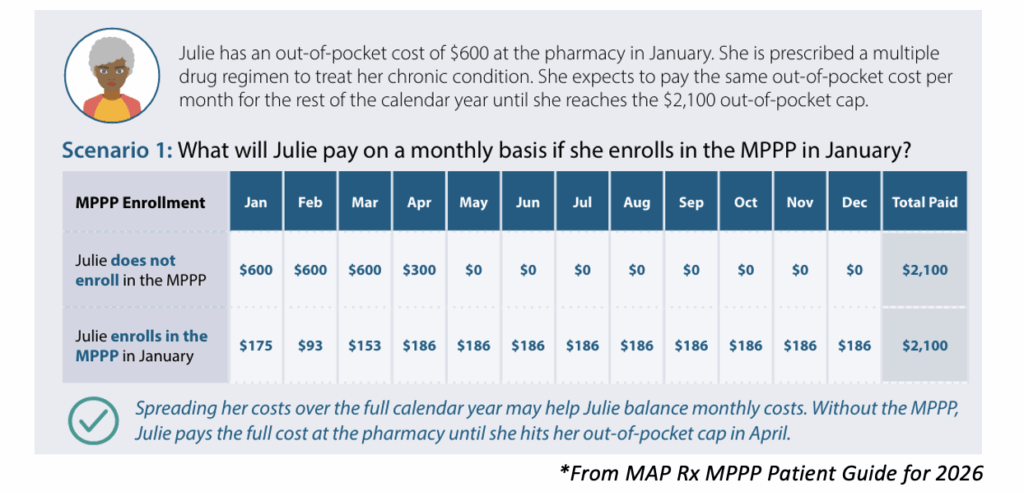
The calculation for the monthly payments under the MPPP, is not simply dividing $2,100 by 12 months in the year. Let’s look at how the math works:

January:
February:
March:
April:
It is important to realize that if you are prescribed a drug later in the year, the math would start in whatever month you first have to pay for the drug. For example, if you only have four months left in the year, your monthly payments will be higher.
The MPPP is run by your Part D plan or Part C plan with prescription drug coverage. It is a voluntary program, so you have to sign up with your Part D or Part C plan to participate. You can sign up at any time during the year, before December. However, if you go to the pharmacy to pick up a drug and then decide that you want to participate in the MPPP, you cannot sign up at the pharmacy. You will have to contact your Part D or Part C plan to sign up and then pick up your prescription.
Your plan should provide a phone number, website, or mail-in option to sign up for the MPPP. They may provide a form called the “Medicare Prescription Payment Plan Participation Request Form.” If you enrolled in the MPPP in 2025, and want to stay enrolled for 2026, you will be automatically re-enrolled. But if you make changes to your plan, then you will need to sign up for the MPPP with your new plan.
If you sign up in the middle of a plan year, the plan must process your application within 24 hours. If you sign up before the next plan year begins, they must process the application within 10 days, or by January 1, which is sooner.
Part D and Part C plans are required to identify people who may benefit from the MPPP and provide them with information on how to sign up. People who are most likely to benefit from the MPPP are people who are taking expensive drugs early in the calendar year. People who are less likely to benefit from the MPPP, include:
To help decide if the MPPP would benefit you, you can preview your monthly drug costs using this tool from Medicare.
• For more information, about the MPPP and Medicare prescription drug coverage, visit: TriageCancer.org/cancer-medicare#care-prescriptions.
• If you have questions about how to sign up for the MPPP with your plan, contact your Part D or Part C plan directly.
For more information, explore our Medicare Materials & Resources, and visit CancerFinances.org.
Last updated: 12/2025
Disclaimer: This handout is intended to provide general information on the topics presented. It is provided with the understanding that Triage Cancer is not engaged in rendering any legal, medical, or professional services by its publication or distribution. Although this content was reviewed by a professional, it should not be used as a substitute for professional services. © Triage Cancer 2025
We're glad you find this resource helpful! Please feel free to share it with your communities or to post a link on your organization's website. However, this content may not be reproduced, in whole or in part, without the express permission of Triage Cancer. Please email us at info@TriageCancer.org to request permission.
This Quick Guide can be downloaded and printed for free. If you are a health care professional, we provide free, bulk copies of many of our resources. To make a request, visit TriageCancer.org/MaterialRequest.