A new federal law changes how people qualify for Medicaid. Starting 1/1/27 (or earlier in some states), many adults with Medicaid must meet a “community engagement” requirement, or qualify for an exclusion or exception, and then report to the state that they meet the requirement. This Quick Guide explains who has to meet the requirement, who qualifies for exclusions and exceptions, and what activities count.

What is Medicaid?

Medicaid is a federal program that provides free or low-cost health insurance. As of May 2026, about 73.5 million people are covered by Medicaid and CHIP (~1 in 4 Americans). It’s a federal-state funding partnership: the federal government helps pay for it, but each state runs its own program and can customize it through §1115 waivers. For information about Medicaid: TriageCancer.org/QuickGuide-Medicaid.

Who has to Meet the Requirement?

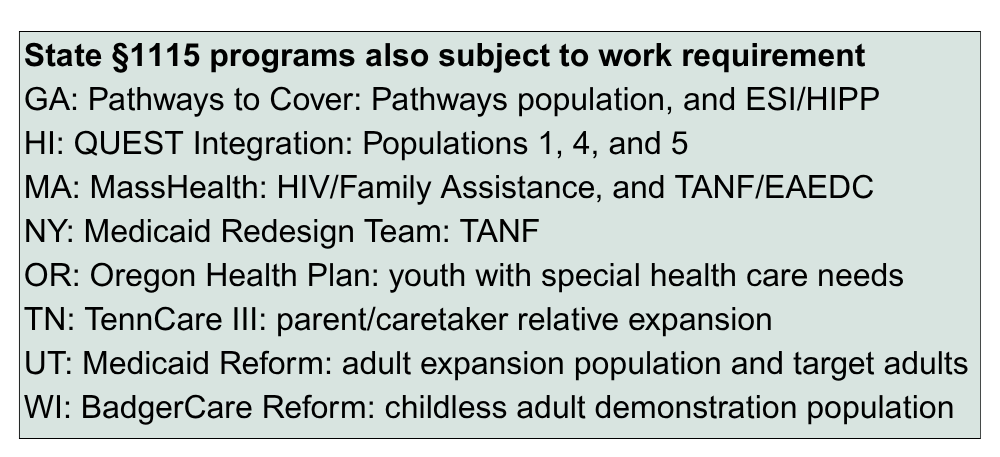
The work requirement applies to adults, ages 19 to 64, who have Medicaid Expansion (or are in the programs in the box below).

When Does it Start?

States must start the requirement no later than 1/1/27. A few states started earlier:

  • NE: 5/1/26
  • MT: 7/1/26
  • AR: 7/1/26 (soft launch only)
  • IA: 12/1/26
  • GA: has had a work requirement since 7/23

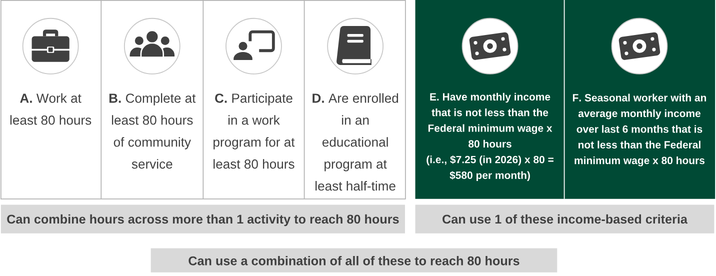
What Counts Toward the 80-hour Work Requirement?

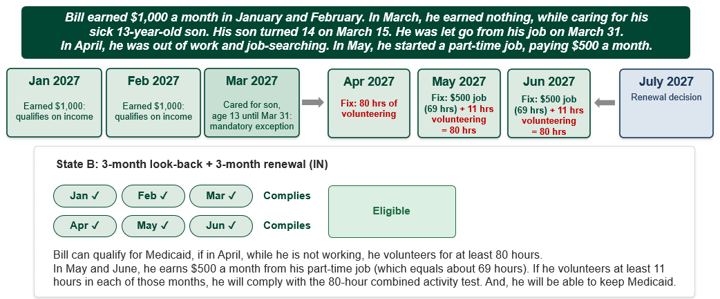
The “community engagement” requirement is commonly called the “work requirement,” even though an individual can meet the requirement by doing one activity (e.g., work), or a combination of activities to meet the requirement, each month.

Who is “Specifically Excluded” from the Work Requirement?

“Specified excluded individuals” do not have to meet the work requirement at all. This status is assessed at application or renewal, and includes:

  • People who are medically frail (see box below) or otherwise have special medical needs
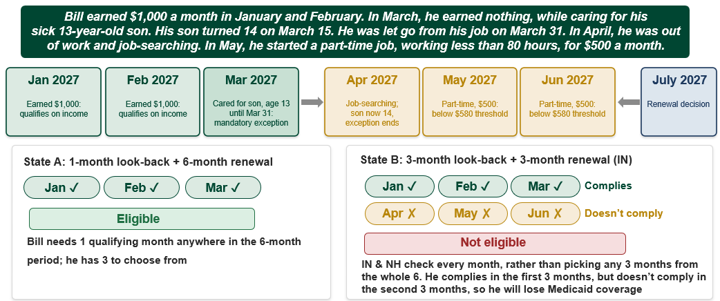
  • A parent, guardian, caretaker relative, or family caregiver (see box below) of a dependent child age 13 or under, or of a person with a disability
  • Veterans with a total (100%) disability rating
  • People already complying with TANF work requirements
  • Members of households subject to SNAP work requirements
  • Participants in certain substance use disorder treatment or rehabilitation programs
  • Inmates of a public institution
  • Pregnant women, or people entitled to postpartum medical assistance
  • Former foster care youth
  • American Indians and Alaska Natives

Who is Medically Frail?

A person is medically frail if they:

  • Have a serious or complex medical condition
  • Are blind or disabled
  • Have a substance use disorder
  • Have a disabling mental disorder
  • Have a physical, intellectual, or developmental disability that significantly limits their ability to perform daily activities

+

The condition must significantly impair the person’s ability to meet the community engagement activities.

Note: CMS considers a serious or complex medical condition to be life threatening, seriously disabling, causing significant pain that disrupts daily life, requiring major caregiver time, frequent monitoring, affecting multiple organ systems, or requiring coordinated specialty care, among other factors.

But, each state will create its own list of qualifying conditions.

Who is a Caregiver?

A caregiver is an adult family member, or other individual, who has a significant relationship with, and provides care to:

  • a dependent child age 13 or under
  • a person with a disability (ADA definition)

A family caregiver is “specifically excluded” if they:

  • Primarily live with the child or person with a
    disability; or
  • Are a relative, even if they don’t live together; and
  • Provide at least 80 hours a month of assistance that is not solely incidental in nature.

What are the “Mandatory Exceptions” to the Requirement?

A person does not have to meet the requirement for a certain month if, for all or part of that month, they were:

  • Under age 19
  • Entitled to or enrolled in Medicare Part A, or enrolled in Part B
  • Originally receiving Medicaid through a non-expansion program, but have lost that eligibility and now receive Medicaid Expansion
  • A specifically excluded individual (see above)
  • An inmate in the 3 months before the requirement period

What are the “Short-term Hardship Exceptions” to the Requirement?

States can choose to offer these, but if they do, they must offer all of them.
A hardship event, for all or part of a month before application or renewal, includes:

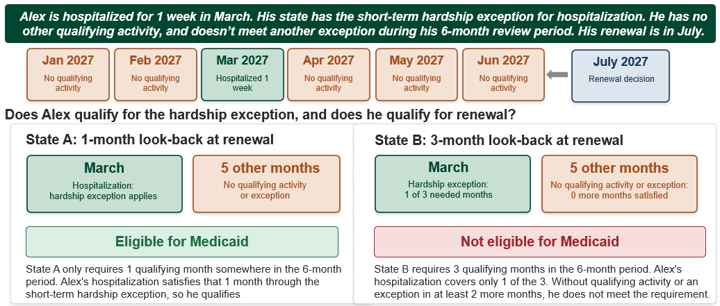
  • Inpatient hospital, nursing facility, intermediate care facility, or inpatient psychiatric services
  • Travel outside the individual’s community (for themselves or a dependent) for an extended time to get medical care for a serious or complex medical condition, not available locally
  • Living in an area under a presidentially declared national emergency
  • Living in an area under a presidentially declared Stafford Act disaster
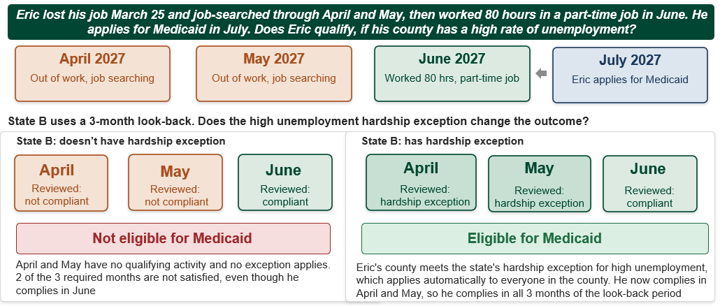
  • Living in a county where the unemployment rate is at or above 8% or 1.5x the national rate, whichever is less

What Decisions have States Made?

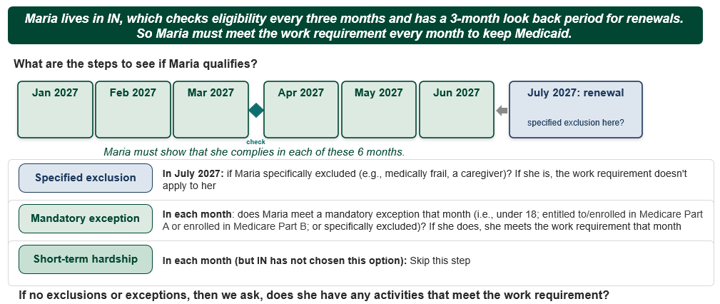
  • Eligibility checks: most states will check income eligibility and if the work requirements have been met every 6 months (the minimum); IN & NH check every 3 months.
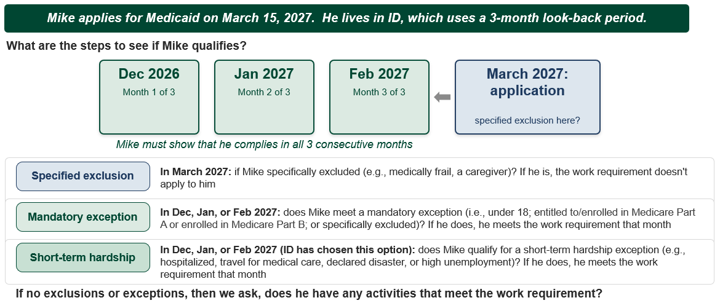
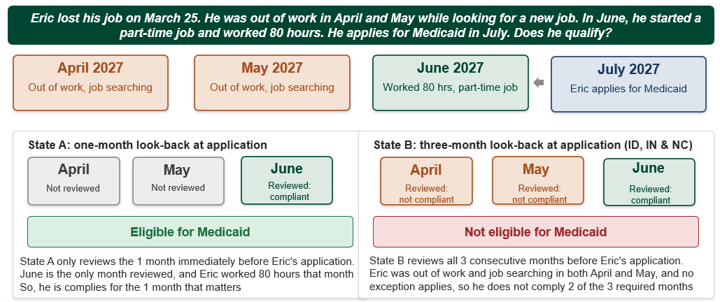
  • Work requirement look-back period at application: states choose 1, 2, or 3 consecutive months before the application month.
    • Note: ID, IN, & NC use 3 months.
    • Note: for IN, because eligibility checks are every 3 months, you have to show you comply every month.
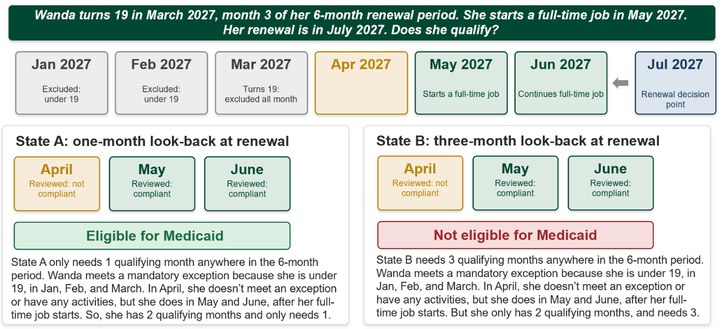
  • Work requirement look-back period at renewal: if a state reviews every 6 months, the review period is any 1, 2, or 3 months before renewal. They do not need to be consecutive. (Note: AR, KY, & NC use 3 months.)

How are States Verifying Compliance?

  • States must check to see if you qualify using data they already have (“ex parte”), such as wage or medical claims data. If that’s enough to confirm you qualify, the state can’t require extra paperwork.
  • In 2027, states may accept self-attestation (a signed statement from an individual, no supporting documents required).
  • Each state will create their own form.
  • AR, ID, IN, NC, NH, & OH will not accept self-attestation in 2027.
  • Starting 1/1/28, states must require documentation if reliable data isn’t available.

Tips for Dealing with Work Requirements

Keep your paperwork

  • pay stubs
  • volunteer or caregiving hours
  • school or work program records
  • medical records
  • job-search records (helps for unemployment)

Use a calendar

  • track hospital stays or travel for treatment

Open your mail, email, and online portal

  • In most states, the first notices about the new requirements went out 9/26

If you get a Notice of Noncompliance, respond!

  • You have a short window to prove you comply with the work requirement or show you qualify for an exception

For details about these requirements and state rules, visit: TriageCancer.org/HealthInsuranceChanges.

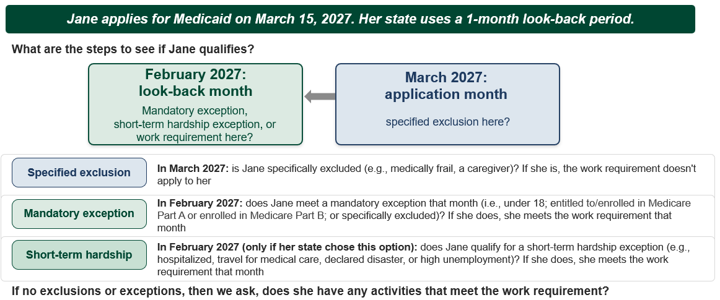
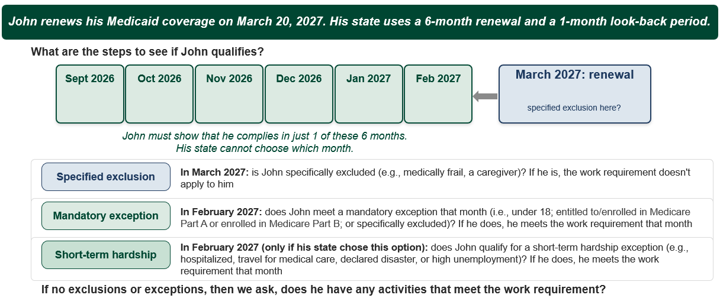
These examples show the step-by-step process to figure out if someone qualifies for Medicaid at application, or renewal, based on the state that they are in.

These examples show how to apply the step-by-step process, to figure out if someone qualifies for Medicaid at application, or renewal, based on the state they are in.

For more information about Medicaid and other health insurance options,
visit TriageCancer.org/HealthInsurance or CancerFinances.org.

Last updated: 10/2026

Disclaimer: This handout is intended to provide general information on the topics presented. It is provided with the understanding that Triage Cancer is not engaged in rendering any legal, medical, or professional services by its publication or distribution. Although this content was reviewed by a professional, it should not be used as a substitute for professional services. © Triage Cancer 2026

Sharing Triage Cancer’s Quick Guide to Medicaid “Work Requirements”

We’re glad you find this resource helpful! Please feel free to share it with your communities or to post a link on your organization’s website. However, this content may not be reproduced, in whole or in part, without the express permission of Triage Cancer. Please email us at info@TriageCancer.org to request permission.

This Quick Guide can be downloaded and printed for free. If you are a health care professional, we provide free, bulk copies of many of our resources. To make a request, visit TriageCancer.org/MaterialRequest.

Questions about insurance, work, or benefits? I’m Lane — ask me anything.